Best Vibrating Collars for Deaf Cats: Features and Buyer Guide
A vibrating collar can offer a deaf cat a tactile cue, but it should be used as a gentle signal—not as punishment. Of the options below, the eXuby collar is the most straightforward pick for buyers seeking a cat-focused training collar with vibration among its correction modes. The other options list adjustable vibration but also include static stimulation, so owners should check whether that function can be avoided and consider guidance from a veterinarian or qualified cat behavior professional.
| Product | Best suited for | Listed vibration details |
|---|---|---|
| eXuby Cat Training Collar | Buyers seeking a cat-focused design | Three correction modes; nine intensity levels |
| DTCollar Ultra-Small Collar | Buyers who want many vibration settings | Vibration levels 1–100 |
| PaiPaitek Training Collar | Buyers considering automatic meow response | Vibration levels 1–100 |
| FASHILEAD Small Cat Collar | Buyers seeking a compact receiver | Vibration levels 1–16 |
| Tiniest Cat Training Collar | Buyers seeking a woven adjustable strap | 99 total adjustable levels across modes |
eXuby Small Cat Training Collar
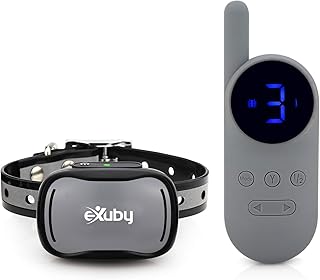
Best for: Cat owners who want a collar described as designed for cats rather than adapted from a dog collar. The listed features include three correction modes, nine intensity levels, a water-resistant design, a remote, and two colored faceplates. It is a reasonable option to investigate if you want a simpler set of intensity choices than collars advertising dozens of levels.
The product description does not specify the names of all three modes or give a vibration-level range. Confirm that it offers a vibration-only setting before buying it for a deaf cat. Its description also promotes correcting behaviors such as meowing and scratching; those goals are different from using vibration as a gentle communication cue.
DTCollar Ultra-Small Remote Collar

Best for: Buyers prioritizing a compact receiver and detailed vibration adjustment. The listed receiver measures 1.57 by 0.78 inches and weighs one ounce; its nylon strap adjusts from 6 to 24 inches. Modes include beep, vibration, shock, and beep plus vibration, with vibration adjustable across 100 levels. The description also lists different silicone contact accessories for long- and short-haired cats and insulated caps for avoiding the shock function.
Choose this only if the fit and settings suit your cat and you can select vibration without static stimulation. The product lists shock modes alongside vibration, so it is not a vibration-only device. Check the collar fit and monitor your cat’s response rather than assuming the smallest setting is appropriate.
PaiPaitek Collar With Auto Mode

Best for: Owners comparing remote control with an automatic response feature. The description lists a one-ounce receiver, an adjustable 8-to-27-inch strap that can be trimmed, and manual beep and vibration settings with 1–100 vibration levels. Its auto mode is described as detecting meows and using a progressive response sequence.
That auto mode is intended for meowing, not for sending a deliberate cue to a deaf cat. The listed sequence may include static stimulation, so do not assume it provides vibration-only operation. Before considering this model, verify how to disable unwanted modes and whether its automatic behavior fits your intended use.
FASHILEAD Compact Cat Collar

Best for: Buyers looking for a compact receiver with a stated minimum weight recommendation. The description says the receiver weighs one ounce and is intended for cats over five pounds. Its modes include sound, vibration with 1–16 levels, and shock with 1–16 levels. It also lists a remote, rechargeability, waterproofing, and a 2,000-foot range.
Those range and mode features may be more than needed for a simple tactile cue. The listing includes shock, and the supplied information does not describe a vibration-only model. Check the cat’s weight and the control settings carefully; avoid using a mode that could deliver static stimulation.
Tiniest Cat Training Collar

Best for: Buyers who want an adjustable woven strap and a compact receiver. The listed receiver measures 1.8 by 1 inch and weighs 1.2 ounces. The breathable strap adjusts from 0 to 27 inches, and the modes include sound, vibration, and optional shock, with 99 adjustable levels across the training settings.
The listing does not break down how many of those levels apply specifically to vibration. Confirm vibration-only operation and adjustability before purchase. Its shock option means owners seeking a device with no static-stimulation capability should choose a different product.
Buying Guide: Choosing A Vibration Collar For A Deaf Cat
Can vibration serve as a cue?
It can be considered as a tactile signal, but a collar should not be treated as a substitute for training or supervision. Introduce the sensation gradually, pair it with a positive outcome such as a treat, and stop if your cat appears distressed. Ask a veterinarian or qualified behavior professional for advice, especially if your cat has health concerns or reacts negatively.
How important is vibration-only operation?
It is central when the goal is communication rather than correction. Several products here also list shock or static stimulation. Read the controls and instructions to verify whether those functions can be disabled, and do not rely on a product title alone to establish how it operates.
What fit and weight details should buyers check?
Compare the receiver’s weight and dimensions with your cat’s size, then check the stated strap range. The products list receivers weighing about one to 1.2 ounces, but strap ranges differ substantially. A collar that is too loose or tight may be unsuitable; follow the manufacturer’s fitting directions and inspect the neck regularly.
Are automatic meow modes useful for deaf cats?
Not necessarily. An automatic mode designed to detect meowing serves a different purpose from a deliberate vibration cue. Read the mode description closely, particularly if the sequence can escalate to static stimulation.
Frequently Asked Questions
Is a vibrating collar appropriate for every deaf cat?
No. Cats differ in comfort and sensitivity. Introduce any tactile cue cautiously and consult a veterinarian if you are unsure whether it is suitable.
Which listed collar has the most vibration levels?
The DTCollar and PaiPaitek descriptions list vibration adjustment from levels 1 to 100. More levels do not establish that a collar is more suitable or comfortable for a particular cat.
Do these products all offer vibration-only use?
The supplied descriptions do not establish vibration-only use for every product. Several explicitly list shock or static stimulation, so verify the available controls before buying.
Should vibration be used to punish a deaf cat?
No. For a deaf cat, a gentle, predictable vibration is better considered as a trained cue, paired with positive reinforcement—not as punishment or a startle tactic.