Best Products to Stop Cats From Scratching at Doors
To stop a cat from scratching a door, protect the scratched area or change the door setup that triggers the behavior. CHUANGSEED and Petslucent offer cut-to-fit clear adhesive protection; CLAWGUARD provides a larger, removable shield; FixZilla supplies multiple protective sheets; and Door Buddy can help when scratching happens because a cat wants a closed door opened. Choose based on the location and size of the damage, the door surface, and whether you need a barrier or a door-latching solution.
| Product | Best For | Protection Type |
|---|---|---|
| CHUANGSEED Door Protector | Long, narrow areas | Clear adhesive strip |
| Petslucent Scratch Tape | Cut-to-fit coverage | Self-adhesive protector |
| FixZilla Protector | Multiple small areas | Adhesive sheets and twist pins |
| Door Buddy Latch | Keeping a door slightly open | Adjustable strap and latch |
| CLAWGUARD Shield | Large door surfaces | Removable, knob-mounted shield |
CHUANGSEED Clear Door Protector

Best for: Protecting a long, narrow section of a door or frame from claw marks. This clear protector measures 118 by 8.2 inches and can be cut to the length or shape needed. Its transparent design is intended to protect surfaces while remaining less noticeable than an opaque guard.
Installation involves cleaning and drying the surface, then applying the adhesive fasteners. It is listed for doors, door frames, screens, glass, and window sills, making it a flexible option for identifying and covering a cat’s usual scratching spot.
Limitation: It covers a strip rather than a broad door panel, so it may not suit cats that scratch across a large area.
Petslucent Cut-To-Fit Scratch Tape

Best for: Cat owners who want a flexible protector they can trim to match a particular door area. The roll measures 118 by 7.9 inches, and the self-adhesive material can be cut to size before application. The product is described for doors as well as carpets, sofas, and other furniture.
Petslucent states that its adhesive is designed to come off without leaving residue. That makes it a useful candidate for renters or people who may want to reposition or remove the barrier, though the product description does not specify how it performs on every door finish.
Limitation: Like other narrow rolls, it may require multiple strips to cover a wide or tall scratching zone.
FixZilla Multi-Piece Cat Scratch Protector
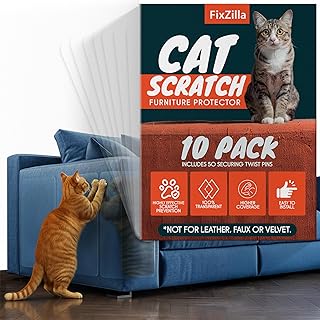
Best for: Covering several smaller problem spots or keeping extra pieces available for different doors and furniture. This set includes 10 protectors and 50 twist pins. The sheets are described as clear, thin, flexible, and durable, with adhesive backing intended to defend surfaces from clawing.
FixZilla is a practical choice when scratching is not limited to one door or when you need to cover corners and edges. The product description says the adhesive does not leave sticky residue, but it also identifies materials to avoid.
Limitation: The manufacturer does not recommend using it on real leather, faux leather, or velvet. Check whether the door finish is suitable before applying.
Door Buddy Adjustable Cat Door Latch

Best for: Cats that scratch because they want access through a closed interior door. Instead of shielding the surface, Door Buddy holds a door partly open so a cat can pass while helping keep a dog out of a room, litter box, or feeding area.
The adjustable strap lets the user set the opening width, and the product description says installation uses adhesive and requires no tools. It may address the cause of scratching when a cat is asking for access rather than simply protecting the finish.
Limitation: The instructions say not to install it on drywall. It is a door-access solution, not a scratch shield for a cat that scratches the door for other reasons.
CLAWGUARD Heavy-Duty Door Shield

Best for: Covering a broader door area without sticking anything to the finish. The 20-by-44-inch shield is designed to slip over a doorknob, with no adhesive, screws, or hardware required. It can be installed or removed as needed and is described for doors, frames, and walls.
Choose this if your cat scratches a large section near the door or if you prefer a removable shield. Its larger dimensions offer more coverage than a narrow tape roll, while the over-the-knob setup avoids adhesive application.
Limitation: The shield must be positioned at a door with a compatible knob placement; it may not cover every scratch location or door design.
Buying Guide: How To Choose A Door Scratch Protector
Where does your cat scratch?
For a narrow scratch line along an edge or frame, compare the cut-to-fit CHUANGSEED and Petslucent rolls. For damage spread across a larger panel, the CLAWGUARD shield offers a wider coverage area. FixZilla is worth considering when several small spots need protection.
Does your cat scratch to get through the door?
If scratching occurs when a cat is shut away from a room, consider whether keeping the door slightly open would solve the problem. Door Buddy is designed to hold an interior door ajar while limiting access for a dog. A physical shield is more suitable when the cat scratches regardless of whether the door is open.
Will adhesive work on your door finish?
Adhesive products can be convenient, but door finishes vary. Review the product’s material cautions and test application in an inconspicuous spot if appropriate. Avoid the FixZilla protector on the leather, faux leather, and velvet materials named in its product information. For a no-adhesive option, consider a knob-mounted shield if its placement suits the door.
How much area needs coverage?
Measure the scratched section before choosing. A narrow strip can be easier to place precisely, while a large shield may cover more of the door in one piece. For irregular shapes or multiple locations, a cuttable roll or multi-piece set may be more adaptable.
Frequently Asked Questions
What is the quickest way to protect a door from cat scratches?
Cover the exact scratched area with a suitable clear protector or a removable shield. Measure the area first so the barrier covers where the claws actually land.
Can a door latch stop scratching?
A latch may help if the cat scratches to get through a closed door. It does not protect the surface from scratching caused by other triggers.
Are clear scratch protectors suitable for every door?
No. Adhesion and fit can depend on the finish and door design. Check the product’s material guidance and coverage dimensions before choosing.
Which option avoids adhesive?
CLAWGUARD is described as a shield that slips over a doorknob without adhesive, screws, or hardware.
Should a protector cover the whole door?
Not necessarily. A focused barrier can work if the scratching is confined to one area. Broad or scattered damage may call for a larger shield or multiple pieces.