Best Incubators for 100 Eggs: Reliable Options for Home, Farm or Classroom
Choosing the right incubator for around 100 eggs involves balancing capacity, automatic turning, humidity control and ease of use. The following selected products offer capacities near or above 100, with multiple automatic modes, temperature stabilization and built-in monitoring features. This guide highlights practical choices for hobbyists, small farms or educational settings seeking dependable hatch rates.
| Product | Capacity | Highlights |
|---|---|---|
| 120 eggs | 5 incubation modes, day counter, external water refill | |
| 182 eggs | Fully automatic, LED display, built-in water channels | |
| 150–180 eggs | Simple operation, 360° roller rotation, built-in candler | |
| 136 eggs | 5 modes, day counter, adjustable tray spacing | |
| 96 eggs | Automatic turning, humidity display, alarm features |
Each option supports reliable incubation for common poultry species, with varying capacities and features. Read on to compare these models, then use the buying guide to match your needs to the right choice.
Chalixion 120-Egg Incubator

The Chalixion incubator supports five incubation modes, including four automatic programs for different temperature profiles and one constant-temperature option for custom settings. It features an automatic incubation day counter displayed to help manage hatch timing and an external water refill device that prevents heat loss when replenishing water, aiding consistent humidity and temperature stability during the hatch cycle. Alarm notifications alert users to deviations, helping minimize risks during critical stages of development. This model targets users seeking a larger-capacity option with a balance of automation and control.
Sailnovo 70 Egg Incubator

Note: While capacity is below 100 eggs, this model demonstrates practical design features for home or classroom use, with roomier trays and an intelligent humidity system. It emphasizes temperature stability through high-power heating and a fan-driven airflow system, plus an external waterer to maintain humidity without opening the lid. A styrofoam cover enhances insulation in cooler environments. This option is useful for educators or hobbyists who want to observe incubation processes with a compact footprint.
Vevitts 136-Egg Incubator

This incubator offers five automatic incubation modes, including preset options for different bird species and a constant temperature mode for custom settings. It includes automatic humidity control through water add bases and pipes, helping to stabilize moisture levels. The adjustable egg tray spacing accommodates various egg sizes and types, from chickens to ducks and quails. Rapid and uniform heating, combined with insulated construction, supports reliable hatching in moderate to larger operations.
Vevitts 136 Eggs Incubator (Alternative)
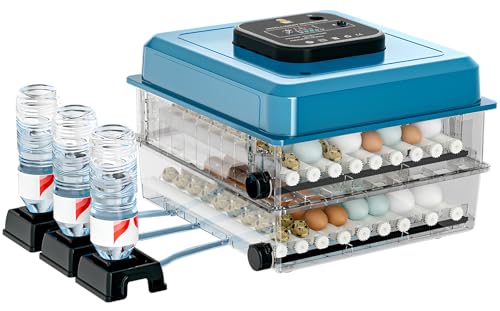
This variant reinforces five automatic modes with a 136-egg capacity and a built-in day counter. It emphasizes intelligent humidity and temperature control, using three automatic water-adding bases and pipes. A transparent lid and internal layout enable easy observation of embryo development without frequent lid openings. The product is well-suited to environments where consistent monitoring is essential for successful hatch outcomes.
Winado 96-Egg Incubator

The Winado model pairs automatic egg turning with a comprehensive temperature and humidity display, enabling precise monitoring of environmental conditions. An alarm system flags high or low temperature and humidity, helping prevent conditions that could compromise hatch rates. The design targets users who want dependable automation with clear feedback on incubation progress and a straightforward setup for mixed-species egg incubation, including ducks, geese and quail.
Buying Guide: Key Considerations For Your 100-Egg Incubator
- Capacity and scalability: If you regularly hatch around 100 eggs, consider models in or above that range (120–180 eggs) to accommodate future growth or batch variations.
- Automatic turning and timing: Automated egg turning reduces manual labor and helps ensure even embryo development. Look for adjustable turning intervals and a reliable day-counter to track incubation progress.
- Temperature control: Precise, stable temperatures are critical. Models offering multiple preset modes for different species (chicken, duck, goose, quail) help tailor conditions to egg type.
- Humidity management: Humidity control is essential for hatch success. External waterers, auto humidification, and humidity range specifications (RH) matter depending on species and climate.
- Observation and monitoring: Built-in egg candlers, transparent lids, and day counters aid regular checks without disturbing the internal environment.
- Ease of refilling and maintenance: External water refill features and accessible components minimize disruption to temperature and humidity during water changes.
- Durability and insulation: Insulated housings and high-quality heating elements support stable conditions in varying room temperatures.
- Safety features: Alarms for temperature or humidity deviations reduce the risk of unnoticed environmental shifts during incubation.
- Electrical and setup considerations: Check voltage compatibility, included cords, and whether the unit comes with a battery option for power outages if needed.
- Budget vs. value: Higher-capacity units with advanced features tend to cost more, but can save time and improve hatch rates for serious breeders.
When selecting an incubator for roughly 100 eggs, analyze your typical hatch batch size, the species you incubate, and your capacity for regular monitoring. Models with automatic turning, reliable humidity systems, and clear progress indicators generally offer the best balance between convenience and hatch success, whether used in a home operation, school setting or small farm.