Best German Shepherd DNA Test Kits for Accurate Breed, Health &Amp; Relations
When buyers search for a German Shepherd DNA test, they typically want reliable breed identification, health risk insights, and connections to relatives. This guide highlights five top options, explaining who each is best for and why. The focus is on accuracy, breed coverage, health reporting, and family-m finder features to help you make an informed choice for your shepherd mix or purebred companion.
Summary of selected products:
- Embark Breed ID Dog DNA Test Kit — 400+ breeds, strong breed accuracy, relative finder, deep ancestry.
- Embark Breed & Health Dog DNA Test — 400+ breeds with 270+ health risks, allergy risk scores, trait insights.
- Wisdom Panel Essential Dog DNA Test — 430+ breeds, 30 health tests, large breed database.
- DNA MY DOG – Dog DNA Test Kit — 350+ breeds, allergy risk, behavior insights, fast results.
- Wisdom Panel Breed Discovery — 430+ breeds, MDR1 health test, large relative matching.
Embark Breed ID Dog DNA Test Kit
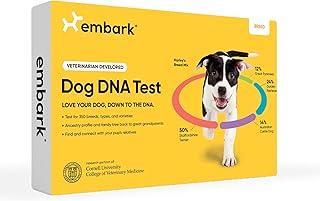
The Embark Breed ID test screens for over 400 dog breeds using a research-grade genotyping platform developed with Cornell University College of Veterinary Medicine. It is best for buyers seeking a comprehensive breed breakdown and an active relative finder to map family connections. For German Shepherd owners, it helps confirm breed purity in mixedLineage or locate potential relatives within a large database.
Best for: owners who want broad breed detection and a robust relative finder to trace family connections. Reasons for selection include extensive breed coverage and university-backed accuracy. Limitation: while breed results are extensive, some very rare regional mixes may show ambiguous results.
Embark Breed & Health Dog DNA Test
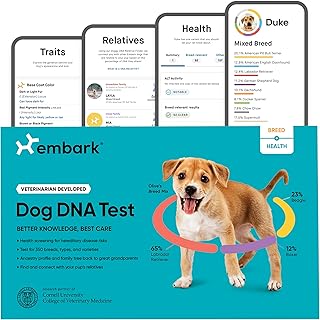
This kit adds health insights to breed analysis, screening for over 270 genetic conditions and including an allergy risk score and 55 trait insights. It’s ideal for German Shepherd owners who want proactive health planning alongside breed identification. The test connects users with canine relatives and includes trait information that helps anticipate grooming needs and size expectations.
Best for: owners who want actionable health guidance alongside breed details. Choose this if you prioritize early risk awareness and trait awareness. Caution: health risk scores are probabilistic and should be discussed with a vet for context.
Wisdom Panel Essential Dog DNA Test

The Wisdom Panel Essential kit covers 430+ breeds and offers 30 health tests, making it a strong choice for comprehensive breed accuracy and health screening. Its large breed database and relative matching allow shepherd owners to explore ancestry and relatives while understanding potential health considerations tied to the breed spectrum.
Best for: buyers who want a broad database with reliable breed detection and substantial health testing. Better for: households seeking a balance of breadth and practical health data. Limitation: some owners may need additional vet interpretation to understand long-term health implications.
DNA MY DOG – Dog DNA Test Kit

DNA MY DOG offers identification of 350+ breeds with 99%+ accuracy and an allergy risk score, plus personality and behavior insights. Results are delivered in 2–3 weeks, with a downloadable DNA certificate. This option suits households seeking a fast, cost-conscious test with actionable breed and behavior information.
Best for: budget-conscious buyers who want quick results and practical breed insights. Choose this if you prefer a concise report and faster turnaround. Caution: while accuracy is high, the report may be less detailed on ultra-rare breeds compared to larger databases.
Wisdom Panel Breed Discovery Dog DNA Test Kit

This kit emphasizes the world’s largest breed database to identify 430+ breeds and ancestry, with relatives matches and an MDR1 health test option. It’s well-suited for German Shepherd owners who want in-depth breed discovery, relative matching, and medication sensitivity insights for safe treatment decisions.
Best for: buyers seeking deep ancestry, broad breed coverage, and health screening that includes medication sensitivity data. Limitation: the MDR1 test is an optional health component, so verify coverage if that specific test is important to you.
Buying Guide: Key Considerations for German Shepherd DNA Tests
What should you look for when choosing a German Shepherd DNA test kit?
- Breed coverage: For shepherds, a kit should identify German Shepherd lines reliably and detect common mixes. Look for 400+ breeds as a baseline.
- Health insights: If health management is a priority, select kits offering 30–270+ health conditions and trait insights to support vet-guided care.
- Relative finder: Family connections can be valuable for pedigree and social history. Prefer tests with relative matching and expansive databases.
- Turnaround time: Some providers deliver results in 2–3 weeks; others may take longer. Choose based on your need for prompt information.
- Interpretation support: Access to clear, actionable results helps non-specialists. Look for reports with practical care tips and risk context.
Frequently Asked Buyer Questions
- What is the most accurate breed test for German Shepherds? Answer: The accuracy depends on the lab, but kits from Embark and Wisdom Panel are widely recognized for broad breed coverage and university-backed validation.
- Do these tests reveal health risks? Answer: Many kits include health risk screenings (e.g., MDR1, IVDD-related insights). Results should be discussed with a veterinarian for context.
- Can I find relatives of my dog with these tests? Answer: Several options offer relative finder features, connecting you with potential cousins or other relatives in the database.
- How long does it take to get results? Answer: Typical turnaround is 2–3 weeks, though some may take longer depending on processing and shipping.
- Should I choose one kit over another based solely on breed count? Answer: Not necessarily. Consider health reporting, relative matching, user interface, and how the results will be used.
- Is a larger database always better? Answer: A larger database increases chances of relatives and a more nuanced ancestry view, but the quality of interpretation also matters.