Best Dog Training Clicker Sounds and Sound-Based Training Tools
A dog training clicker creates a consistent sound to mark a behavior the moment it happens, helping a dog connect the action with a reward. For positive-reinforcement training, the Educator Finger Clicker is best for hands-free handling, while the wrist-and-keyring clicker is a straightforward option for everyday practice. The other picks use whistles or ultrasonic sounds rather than a standard clicker, so they suit buyers specifically seeking sound-based cues or behavior tools.
| Product | Best For | Sound Type |
|---|---|---|
| Educator Dog Training Finger Clicker | Hands-free click timing | Audible click |
| Dog Training Clicker With Wrist And Keyring | Simple reward-based practice | Press-activated click |
| Ultrasonic Dog Whistles | Whistle-based recall cues | Ultrasonic whistle |
| PawBehave Adjustable Ultrasonic Dog Trainer | Adjustable sound options | Ultrasonic and whistle modes |
| Rechargeable Dog Bark Deterrent | Ultrasonic behavior training | Fixed-frequency ultrasound |
Educator Dog Training Finger Clicker

This audible finger clicker is best for trainers who want to mark behavior while keeping their hands available for treats, a leash, or other tasks. Its listed purpose is positive reinforcement, behavior training, and obedience. Choose it if click timing and convenient handling matter more than adjustable tones or multiple sound modes.
Limitation: The product information does not specify adjustable volume or sound settings, so it may not suit buyers who need to customize the click.
Dog Training Clicker With Wrist And Keyring

This press-activated clicker is best for buyers who want a simple sound marker for reward-based practice. The listing describes using the click to mark a desired behavior and then giving a reward. It also identifies the tool for puppy training and other pet training, making it a versatile option for households training more than one kind of animal.
Limitation: The listed features do not describe different tones, volume control, or a specialized finger-worn design.
Ultrasonic Dog Whistles
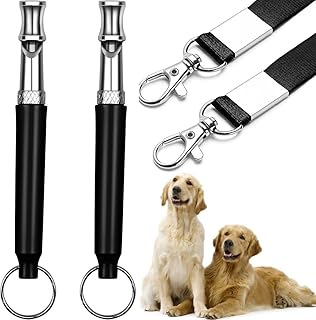
This whistle is best for buyers looking for a sound cue for recall rather than the familiar audible click of a standard clicker. Its name describes an ultra-wide-frequency whistle intended for dog breeds and silent recall training. Consider it if you want to train a distinct whistle cue; it is not the closest match for click-and-reward marking.
Limitation: The supplied product details do not include specific frequency settings or further operating instructions.
PawBehave Adjustable Ultrasonic Dog Trainer

Best for buyers who want several sound options in one device, this trainer lists 10 ultrasonic frequency levels from 20 kHz to 30 kHz and 18 dog-whistle sound modes. It also includes a flashlight with steady and pop-flash modes. These choices make it more configurable than a basic clicker, but it is designed as an ultrasonic trainer rather than a simple audible marker.
Limitation: The product information does not explain how to choose a setting for an individual dog or behavior.
Rechargeable Ultrasonic Dog Bark Deterrent

This device is best for shoppers focused on unwanted behaviors rather than clicker-based skill training. The listing describes a rechargeable, two-in-one ultrasonic trainer with a fixed 25 kHz frequency, intended for barking, chewing, scratching, biting, and jumping. It is presented as a no-shock option, while a clicker is typically used to mark a wanted action and pair it with a reward.
Limitation: Its frequency is fixed, and the product is not described as a standard clicker or adjustable whistle.
Buying Guide: How To Choose A Dog Training Sound
Do you need a clicker or an ultrasonic cue?
Choose an audible clicker if your goal is to mark the exact moment your dog performs a wanted behavior, then follow the sound with a reward. A whistle provides a different cue, often for recall practice. Ultrasonic trainers are a separate category; they should not be treated as interchangeable with a clicker for reward timing.
Which clicker style fits your routine?
A finger clicker can help keep the hand free during training. A basic press-activated clicker is a direct choice for buyers who want a simple marker. Compare the handling style and sound options listed for each product rather than assuming all clickers have the same volume or tone.
How should you use a clicker sound?
Use the sound consistently to mark a behavior, then provide the reward promptly. Start with a quiet setting and a low-distraction environment if your dog is sensitive to sounds. Pairing the click with a reward helps give the sound a clear meaning; the click itself is not a substitute for reinforcement.
Frequently Asked Questions
What sound does a dog training clicker make?
A standard training clicker makes a short, distinct audible click when pressed. The sound marks a behavior so the trainer can follow it with a reward.
Can I use a whistle instead of a clicker?
A whistle can serve as a trained cue, but it does not automatically work like a clicker. Use a consistent signal and teach the dog what it means.
Should I reward my dog after every click?
During initial training, pair the click with a reward consistently so the dog learns its meaning. Follow a training plan suited to the behavior and your dog.
Is an ultrasonic trainer the same as a clicker?
No. An ultrasonic trainer emits high-frequency sound, while a clicker provides a brief marker sound for reward-based training.