Best Coco Blocks for Reptiles: Top Coconut Substrate Picks
A coco block for reptiles is a compressed coconut-based substrate that expands for use in a terrarium. The ReptiChip 72-quart block is best for keepers who want a large compressed chip format, while Repti360 and Riare offer similar 10-pound, 72-quart options. ZeeDix suits buyers seeking smaller packs of coconut fiber, and Zilla is a straightforward choice for organic coconut bedding.
| Product | Format | Best For |
|---|---|---|
| ReptiChip Coconut Chip | Compressed, 72 quarts | Large habitats and bulk use |
| Repti360 Coconut Chip | 10-pound block, expands to 72 quarts | Humidity-focused setups |
| Riare Coconut Husk Chip | 10-pound block, 72 quarts | Burrowing and moisture retention |
| ZeeDix Coconut Fiber | Two smaller packs | Smaller substrate quantities |
| Zilla Coconut Husk | Coconut fiber bedding | Organic bedding and burrowing |
ReptiChip 72-Quart Coconut Chip

ReptiChip is a compressed coconut husk chip block listed as 10 pounds and 72 quarts when expanded. The instructions say to add water to prepare the substrate. Its features highlight humidity retention for tropical terrariums and odor absorption that helps encapsulate waste.
Best for: Keepers who need a larger quantity of chip-style bedding for a snake habitat, turtle tank, or other enclosure where humidity retention is a priority. The stated volume makes it a practical bulk option for breeders and hobbyists.
Limitation: The block needs water and expansion before use, so it is not ready-to-spread bedding straight from the package.
Repti360 Premium Coconut Chip Substrate
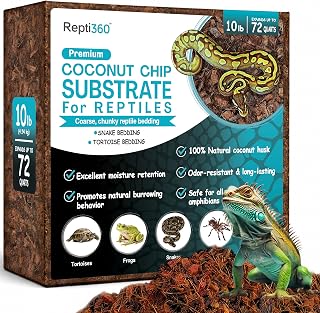
Repti360 is a 10-pound coconut chip block that expands to 72 quarts. The product information describes it as natural and dust-free and emphasizes moisture retention for tropical conditions. It is listed for reptiles including ball pythons, bearded dragons, tortoises, and geckos, as well as amphibians and invertebrates.
Best for: Buyers looking for a large chip-format substrate with a stated dust-free feature and broad listed animal use. Its humidity-retention focus may make it a better fit for enclosures that need help holding moisture.
Limitation: The listed features do not specify an expansion method or detailed preparation instructions, so check the package directions before use.
Riare 72-Quart Coconut Husk Chip

Riare provides a 10-pound compressed coconut husk block listed to expand to 72 quarts. Its features describe the material as soft, clean, odorless, biodegradable, and made from coconut-shell fibers. The loose texture is intended to support digging and burrowing, while water absorption and moisture retention help maintain terrarium humidity.
Best for: Keepers who want chip bedding with an explicit focus on burrowing behavior and moisture retention. The stated volume also suits people preparing substrate for a larger enclosure or multiple habitat changes.
Limitation: This is a compressed block, so it must be expanded before spreading; allow room for the prepared substrate.
ZeeDix Two-Pack Coconut Fiber

ZeeDix includes two coconut fiber packs, each listed at about 1.4 pounds. The product description identifies the fiber as natural, breathable, biodegradable, and low in salt, with balanced pH and low electrical conductivity. It is also described as absorbing liquids and waste and helping reduce odors.
Best for: Buyers who prefer smaller packs rather than a single 10-pound block, or who need coconut fiber for bedding and liquid absorption. Its compact pack format may also be easier to portion for smaller habitat projects.
Limitation: The combined package is much smaller than the 72-quart blocks, so it may not be the better choice when a large enclosure needs substantial substrate.
Zilla Organic Coconut Husk Bedding

Zilla describes this bedding as made from 100% organic coconut fiber. Its listed features include absorbency for humidity control in tropical terrariums and a soft texture that encourages natural burrowing behavior. The product information gives a one-size description but does not state an expansion volume in the supplied details.
Best for: Keepers prioritizing organic coconut fiber and a substrate texture that supports burrowing. Choose this if those material and habitat features matter more than a clearly stated bulk volume.
Limitation: The supplied product details do not specify package weight or expanded volume, making quantity comparisons harder.
Buying Guide: How to Choose a Reptile Coco Block
Do you need chips or fine coconut fiber?
Coconut chips have a chunkier texture, while coconut fiber is a finer bedding format. Consider the texture you want in the enclosure and whether the product specifically describes burrowing support. The products above include both chip-style blocks and fiber bedding, so compare format before choosing by package size alone.
How much substrate should you buy?
Compare the stated expanded volume, not just the package weight. ReptiChip, Repti360, and Riare each list a 72-quart quantity or expansion amount. ZeeDix is sold as two smaller packs, while the supplied Zilla details do not state a volume. A smaller pack can be easier to portion, but may not provide enough material for a large enclosure.
Will the substrate help maintain humidity?
Several products specifically describe moisture absorption or humidity retention. Repti360, ReptiChip, Riare, and Zilla all highlight humidity-related uses. Match substrate choice to the needs of the animal and enclosure, and monitor habitat conditions rather than relying on bedding alone to set humidity.
What preparation does a compressed block require?
ReptiChip says to add water to expand, and the Riare and Repti360 products are also described as blocks. Follow the package instructions for preparation and check the resulting texture and moisture before adding substrate to an enclosure. Do not assume every coconut product has the same expansion directions.
Should odor absorption be a deciding factor?
ReptiChip and ZeeDix list odor or waste absorption as features. This can be useful when comparing products, but substrate does not replace routine enclosure cleaning. Check and maintain the habitat according to the animal’s care requirements.
Frequently Asked Questions
What is a coco block for reptiles?
It is compressed coconut-based substrate that is prepared for use in a terrarium. Some blocks expand when water is added; follow the specific product directions.
Which listed coco block has a stated 72-quart volume?
ReptiChip, Repti360, and Riare each list a 72-quart quantity or expansion amount.
Are coconut chips and coconut fiber the same format?
No. Chips have a chunkier form, while fiber is a finer substrate. Choose based on the texture and habitat use you need.
Can coconut substrate help retain humidity?
Yes. Several products in this list describe moisture absorption or humidity retention. Actual enclosure humidity still needs to be checked and managed for the animal.
Which option comes in smaller packs?
ZeeDix comes as two packs of about 1.4 pounds each, rather than a listed 10-pound block.