Best CO2 for Aquarium Plants: Systems and Carbon Treatments Compared
The best CO2 option for aquarium plants depends on tank size, desired control, and willingness to mix ingredients. The Clscea G600mini is best for small aquariums, while the 2L timer-enabled generator suits buyers who want scheduled injection. The Clscea G200 offers a DIY approach, and MagTool’s larger stainless-steel kit includes integrated controls and safety features. API CO2 Booster is a liquid treatment option for people who do not want a pressurized generator.
| Product | Best for | System type |
|---|---|---|
| Clscea G600mini | Small or desktop aquariums | Compact DIY generator |
| Upgraded 2L Generator | Timed CO2 delivery | Generator with motor valve |
| Clscea G200 | Budget-minded DIY setups | Citric acid and baking soda kit |
| MagTool 2.5–5L Kit | Larger planted tanks | Stainless-steel generator |
| API CO2 Booster | Simple liquid treatment | Carbon treatment |
Clscea G600mini Compact CO2 Generator

The Clscea G600mini is best for small or desktop aquariums where a full-size generator would take up too much room. Its 1-liter tank is packaged with a solenoid valve, bubble counter, diffuser, and other accessories, making it a ready-to-assemble kit.
This system generates CO2 using citric acid and baking soda, which are not included. The manufacturer describes it as refillable, so users can prepare another batch rather than replace the whole system. Its compact size and included components make it a practical choice for limited-space planted tanks.
Consideration: Buyers need to source the citric acid and baking soda separately. Its small tank is aimed at small aquariums, not users seeking a larger-capacity setup.
Upgraded 2L Generator With Timer

This 2-liter generator is best for aquarium keepers who want timed CO2 injection. Its motorized valve allows the user to set intervals, and quick-release connections on the bubble counter, valve, and tubing are designed to make installation and removal easier.
The kit uses citric acid and baking soda, which must be purchased separately. The manufacturer advises soaking the diffuser in the aquarium for 24 hours before use. If bubbles do not appear right away, low initial pressure may be the reason; checking the tube connections for leaks is suggested if the issue continues.
Consideration: The motorized valve is not waterproof and may make a soft sound when switching on or off. Keep the valve away from water and account for the sound when choosing its location.
Clscea G200 DIY CO2 Kit

The Clscea G200 is best for buyers who want a DIY citric-acid-and-baking-soda system for a planted aquarium. It includes a quick reaction test tube, an acid-absorbing ball intended to help control acid consumption, and a pressure gauge with a pressure-relief valve beneath it.
The kit’s materials are specified for repeated use: its tubing is described as pressure-resistant, with the tubing between the two caps also designed to resist acid and hydrolysis. The caps are made from ABS engineering plastic. These details make it a relevant option for hobbyists comparing reusable generator kits and wanting pressure-control components.
Consideration: This is a DIY system rather than a ready-to-use liquid treatment, so setup involves handling the ingredients needed to generate CO2. Review the included instructions before operating it.
MagTool Stainless-Steel CO2 Generator Kit
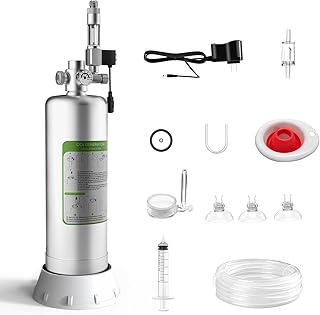
The MagTool kit is best for buyers who want a larger generator with integrated controls. It is offered in 2.5-liter and 5-liter bottle sizes. The listed bottle capacities are 200–300 grams of material for the 2.5-liter version and 600–800 grams for the 5-liter version.
The bottle is made from 304 stainless steel and has an external-thread design. An integrated solenoid and bubble counter reduce the number of separate connections, and a built-in injection port allows the user to observe fluid levels without disassembling the unit. A manual shut-off valve and automatic pressure-relief valve provide two forms of pressure control.
Consideration: Choose the correct bottle size for your setup; the larger option requires more space. The product description does not specify that acid and baking soda are included, so confirm package contents before purchase.
API CO2 Booster Freshwater Treatment

API CO2 Booster is best for freshwater aquarium owners who prefer a bottled carbon treatment over assembling a CO2 generator. The 16-ounce product is described as adding essential carbon in a form plants can absorb from the water and as promoting plant growth.
Unlike the other products in this comparison, it is not a generator kit with a tank, valve, or diffuser. That makes it a simpler product category to consider when a user wants a treatment applied to aquarium water rather than a gas-delivery setup.
Consideration: It is a liquid treatment, not a pressurized CO2 generator. Buyers seeking equipment for controlled gas injection should compare one of the generator systems instead.
Buying Guide: How to Choose CO2 for Aquarium Plants
Do you want a generator or a liquid treatment?
A generator creates CO2 from ingredients and delivers it through aquarium equipment. The Clscea and MagTool kits are options for this approach. API CO2 Booster is a bottled treatment added to freshwater aquarium water, so it does not provide the same equipment-based delivery setup. Choose based on the type of product and routine you want to manage.
What capacity and controls fit your aquarium?
Compare the intended tank scale and available space. The 1-liter G600mini is specifically described for small or desktop aquariums. The 2-liter timer-enabled model emphasizes scheduled injection. MagTool offers 2.5-liter and 5-liter versions. Check the product specifications and available space before selecting a bottle size.
Are ingredients and accessories included?
Some kits include core equipment but require separate ingredients. The G600mini and timer-enabled system both specify that citric acid and baking soda are not included. Check the package details for any kit before buying, and consider whether you already have the required ingredients.
What safety and maintenance details matter?
Look for pressure-management features and follow the manufacturer’s operating instructions. The G200 lists a pressure-relief valve, while MagTool lists manual shut-off and automatic pressure relief. Keep non-waterproof electrical or motorized components dry. Inspect tubing connections and follow diffuser preparation instructions where provided.
Frequently Asked Questions
What does CO2 do for aquarium plants?
CO2 provides carbon that aquatic plants can use. The listed products offer either equipment for generating and delivering CO2 or a liquid treatment described as providing absorbable carbon.
Which product is best for a small aquarium?
The Clscea G600mini is specifically described as suitable for small or desktop aquariums and has a 1-liter tank.
Which kit offers timed CO2 injection?
The upgraded 2-liter generator has a motorized valve with timer settings for controlling injection intervals.
Do these generator kits include citric acid and baking soda?
The G600mini and timer-enabled generator explicitly state that those ingredients are sold separately. Check the package details for other kits before ordering.
Is API CO2 Booster a CO2 generator?
No. It is a bottled freshwater aquarium plant treatment, not a tank-and-valve generator system.