Best Automatic Cat Laser Lights for Indoor Cats
The best automatic cat laser light depends on how your cat plays and how much control you want over play sessions. The YVE LIFE models suit buyers who want three speed settings and longer automatic sessions; TBTeek adds five laser patterns; Potaroma offers clamp mounting and a shorter activation; and ORSDA combines dual lasers with a dangling catnip toy. Compare placement, activation schedules, and play features before choosing.
| Product | Best For | Key Feature |
|---|---|---|
| YVE LIFE, 15-minute model | Longer automatic sessions | Three speeds; motion activation |
| TBTeek | Pattern variety | Five patterns; four speeds |
| Potaroma | Clamp mounting | Random trajectory; sensing and timer modes |
| ORSDA | Mixed types of play | Dual lasers and detachable dangler |
| YVE LIFE, alternate listing | Simple speed options | Three speeds; motion activation |
YVE LIFE Automatic Cat Laser Toy

This YVE LIFE model is best for indoor cat owners who want a motion-activated laser with a longer listed play period. Its dual motor moves the laser point along a random trajectory, and three speed modes—fast, slow, and mixed—let buyers vary the pace.
The sensor starts the toy when it detects a pet within its stated 0–13.1-foot working distance. It runs for 15 minutes, then turns off. The sensor triggers once every two hours, so it is not designed for continuous automatic play. For the suggested play experience, place it on a table 8–35 inches high and avoid corners.
TBTeek Laser Toy With Five Patterns

TBTeek is best for buyers who want more visual variety and multiple speed choices. It has five adjustable patterns, including a mouse, star, butterfly, smile, and red dot, plus four speeds: slow, medium, quick, and mixed. Its rotating laser trajectory is intended to encourage chasing and movement.
The motion-activated toy runs for 10 minutes before entering a two-hour sleep mode. During that rest period, the switch can be pressed to activate it manually. Choose this model if pattern selection matters; avoid it if you want a laser that automatically runs without a scheduled rest period.
Potaroma Clamp-Mount Laser Toy
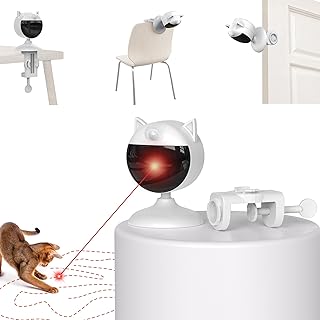
Potaroma is best for buyers who prefer a clamp-style design and want both sensing and timer modes. Its specular-reflection mechanism creates a random laser trajectory. The laser’s speed and range can be adjusted by changing its tilt angle, giving owners a way to alter the play area without selecting a listed speed setting.
In sensing mode, detected activity starts a five-minute session before the toy enters standby. If no activity is detected during standby, it powers off automatically. The product recommends clamping it at least 2.8 feet high. This shorter session may be a limitation for cats that need more time to engage.
ORSDA Dual-Laser Cat Toy With Dangler

ORSDA is best for households that want more than a laser. It pairs adjustable wide- or small-area dual-laser coverage with a detachable UFO dangler containing organic catnip, feathers, a bell, and crinkle material. One laser eye offers five interchangeable patterns. The listed play modes are fast, slow, mixed, and manual.
A motion sensor activates the toy within a stated 6.5-foot range, and a three-hour auto-cycle mode is also listed. Choose it for varied laser and dangling-toy features. Its multiple components and settings may be more than buyers need if they want a simple laser-only device.
YVE LIFE Three-Speed Laser Toy

This alternate YVE LIFE listing is best for buyers seeking a straightforward automatic laser with three speed options. Its dual motor produces a random trajectory, and the available settings are fast, slow, and mixed. The listed motion sensor has a working distance of 0–13.1 feet and activates the toy when it detects movement.
The toy runs for 15 minutes, but the sensor activates only once every two hours. That schedule is an important limitation for buyers expecting frequent automatic sessions. The recommended placement is on a table 8–35 inches high. Its listed features closely match the other YVE LIFE option, so compare the product listing details before deciding between them.
Buying Guide: How To Choose An Automatic Cat Laser Light
How often should the toy activate?
Check both session length and the rest period between activations. The YVE LIFE options list 15-minute sessions with a two-hour sensor interval. TBTeek runs for 10 minutes before a two-hour sleep mode, while Potaroma lists five-minute sensing sessions. These schedules help set expectations, but none should be treated as continuous play.
Do placement and coverage fit your room?
Placement recommendations differ. YVE LIFE suggests a table 8–35 inches high and advises avoiding corners. Potaroma recommends clamp mounting at least 2.8 feet high and lets users change the laser range by adjusting tilt. ORSDA lists wide- and small-area coverage. Consider where your cat can safely move and whether the mounting style suits that spot.
Are extra modes or toys useful?
Choose a pattern-focused toy if your cat benefits from visual variety: TBTeek lists five patterns and four speeds. ORSDA adds a dangling catnip toy for play that does not rely only on chasing a light. If speed adjustment is enough, either YVE LIFE model offers three speeds. Match features to your cat’s play habits rather than choosing the model with the most settings.
Frequently Asked Questions
What does motion activation mean?
A built-in sensor detects nearby movement and starts a play session. The listed detection ranges and activation schedules vary by model.
Which option has the longest listed session?
The YVE LIFE models list 15-minute sessions. TBTeek lists 10 minutes, and Potaroma lists five minutes in sensing mode.
Which toy includes non-laser play?
ORSDA includes a detachable dangling toy with feathers, a bell, crinkle material, and catnip.
Can an automatic laser replace interactive play?
These products provide automatic stimulation, but their listed features do not establish that they replace owner-led play. Consider using them as one part of a cat’s play routine.
What should I compare before buying?
Compare session timing, sensor range, mounting and placement needs, speed settings, and whether you want extra patterns or a dangling toy.