Best 28-Inch Dog Stairs for High Beds and Furniture
The best 28-inch dog stairs match your furniture height, your pet’s size, and the amount of floor space available. MEJYJEM is a strong fit for pets that benefit from a curved five-step climb, while Casusv offers six steps and a stated 60-pound weight limit. MASSFU provides a five-step option rated for furniture up to 29 inches, and A.FATI uses a space-saving L-shaped layout. Compare the details below before choosing.
| Product | Height and steps | Best for |
|---|---|---|
| MEJYJEM | 28.7 inches, 5 steps | Pets needing a curved route |
| Casusv | 28 inches, 6 steps | Small and medium pets up to 60 pounds |
| MASSFU | Up to 29 inches, 5 steps | Small dogs and cats |
| A.FATI | 27–30 inches, 6 steps | Rooms where an L-shaped layout helps |
| kyako | 28.2 inches, 5 steps | Pets needing deeper steps |
MEJYJEM 28.7-Inch Curved Dog Stairs

These five-step foam stairs measure 35.4 inches long, 15.7 inches wide, and 28.7 inches high. MEJYJEM describes a 35-degree curved slope rather than traditional right-angled steps, with high-density foam intended to cushion each step.
Best for: Short-legged dogs, puppies, older pets, or dogs with limited mobility that need a gradual route to a high bed. The added height is useful when a standard 23- or 24-inch stair set would not reach the furniture.
Limitation: The 35.4-inch length requires floor space in front of the bed. Measure the available area as well as the furniture height.
Casusv Six-Step Stairs for High Beds
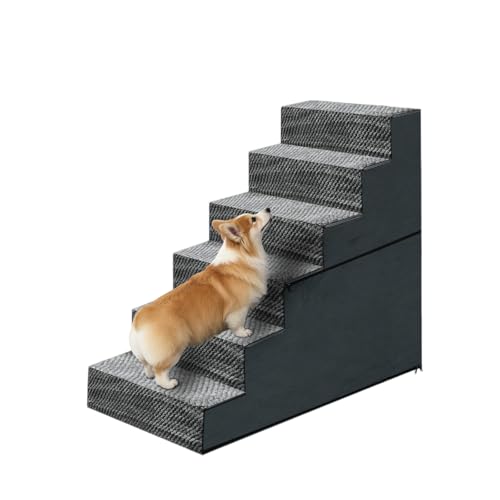
Casusv’s staircase stands 28 inches tall and has six steps. Its high-density foam provides a cushioned climbing surface, while a PP board is listed as a support material. The product is recommended for pets weighing 60 pounds or less.
Best for: Small and medium dogs or cats that may find six steps easier to navigate than a five-step design. Choose this if your pet is within the stated weight recommendation and you want stairs designed for a high bed or couch.
Limitation: The listed weight recommendation excludes pets over 60 pounds. Confirm the pet’s weight before selecting this model.
MASSFU 28.7-Inch Curved Foam Stairs

This MASSFU model uses 35D foam and a low-angle slope. The five-step version is listed for furniture up to 29 inches high; three- and four-step versions are described for lower furniture. The product is designed to sit against a bed, sofa, or other furniture.
Best for: Small dogs and cats whose furniture is close to 29 inches high. It is a useful choice if a gentler slope and foam construction matter more than a rigid stair structure.
Limitation: The available feature information does not state a weight limit or cover-cleaning method. Check the product details for those points if they are important to your purchase.
A.FATI L-Shaped Six-Step Dog Stairs

A.FATI’s six-step design is made for beds 27 to 30 inches high. Its L-shaped arrangement is intended to save space, and the stairs use 30D high-density foam. Wavy steps and a built-in resting area are included in the design.
Best for: Small, senior, or injured pets that need a longer climbing route and a place to pause. The L shape may suit rooms where a straight staircase would extend too far into the floor area.
Limitation: An L-shaped layout needs room beside the bed as well as in front of it. Check the surrounding space before choosing this style.
kyako 28.2-Inch Deep-Step Dog Stairs

These five-step stairs stand 28.2 inches high and measure 35.4 inches in length. The product description highlights deeper steps for paw placement and 35D high-density foam. It is listed for small and medium dogs weighing up to 60 pounds and furniture around 28 to 34 inches high.
Best for: Small or medium pets that need a tall staircase with deeper steps and a cushioned surface. It is the only option here that specifically describes the steps as deeper for more room to climb.
Limitation: The 35.4-inch length may be too large for tight spaces. Measure the room before ordering.
Buying Guide: How to Choose 28-Inch Dog Stairs
How tall should the stairs be?
Measure from the floor to the top of the mattress or furniture surface your pet needs to reach. A staircase that is too short may leave a large final step, while one that is much taller than the furniture may not sit securely at the edge. Check the product’s listed height and intended furniture range.
Are five or six steps better?
More steps can create a more gradual route, but the step count alone does not show how comfortable the climb will be. Compare the total height, step depth, slope, and overall length. A curved or wavy shape may be preferable for pets that struggle with steep, squared steps.
Will foam stairs support your pet?
Look for a stated weight recommendation and foam details. Casusv and kyako list a limit of 60 pounds; other products in this guide do not provide a specific limit in the supplied features. Do not assume that a foam density number establishes a weight capacity.
What should you measure before buying?
Measure the furniture height, the floor space in front of it, and the side clearance if considering an L-shaped model. Also consider whether the stairs need to move between rooms and whether removable or washable covers are a priority.
Frequently Asked Questions
Are 28-inch dog stairs suitable for a high bed?
They can be, but suitability depends on the bed’s measured height and the stair model’s dimensions. Compare the stairs’ height with the top of the mattress.
Are these stairs appropriate for senior dogs?
Several models are described for older pets or pets with limited mobility. Choose a gradual design and consult a veterinarian if your dog has a diagnosed mobility or joint condition.
Can a large dog use these stairs?
Check the individual product’s weight guidance. Casusv and kyako specify a limit of 60 pounds, while the other listed product features do not establish a capacity.
Do foam dog stairs need setup time?
Some compressed foam products may need time to expand. Follow the setup instructions supplied with the specific model before allowing your pet to use it.
Should dog stairs be placed against the bed?
These products are designed to sit against furniture, but placement and stability depend on the floor and stair shape. Position them as directed by the manufacturer and check that they do not shift during use.