Best Chicken Egg Hatching Machines for Home Farms and Hobbyists
Finding the right chicken egg hatching machine depends on your hatchery goals, budget, and household setup. This guide highlights five reliable options that balance automation, ease of use, and hatch success. Best for beginners: compact, simple units with clear displays. Best for small farms: larger capacity with integrated humidity control. Best for learning and experimentation: advanced models with smart features and alarms. Keep reading to compare features, ideal buyers, and practical considerations.
| Product | Best For | Key Benefit |
|---|---|---|
| VEVOR 12 Egg Incubator | First-time hatchers | Clear 360° view window and LED candler |
| 12 Egg Incubator Starter Kit with Plush Chick House | Small family hobbyists | Digital LED display with auto water refill |
| Gen IV 12 Egg Fully Automatic Incubator | Hobbyists seeking automation | Sensor-based humidity and temp with auto-turning |
| 48 Incubators for Hatching Eggs | Multiple eggs / beginners | High-capacity with automatic turning and candler |
| MATICOOPX 20 Egg Incubator | Stable climate control | External water refill and built-in candling |
VEVOR 12 Egg Incubator

VEVOR’s 12 Egg Incubator is ideal for beginners who want a straightforward, all-in-one hatchery. It features automatic egg turning, LED candling, and precise temperature and humidity control. Best for households starting small, it helps first-time hatchers manage incubation with a clear window to monitor progress.
12 Egg Incubator Starter Kit
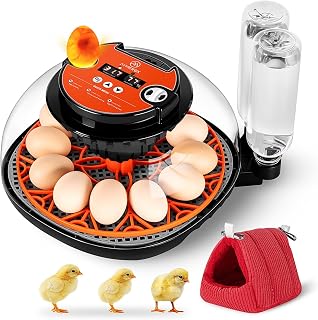
This Starter Kit adds a plush chick house, digital LED display, and an auto water refill system. It’s best for families seeking a more engaging starter experience while learning incubation basics. Choose this if you want integrated monitoring in a compact footprint.
Gen IV 12 Egg Fully Automatic Incubator

The Gen IV 12 Egg Fully Automatic Incubator emphasizes minimal maintenance and high reliability. It features sensor-based humidity and temperature control, adjustable hatch days, auto turning with auto-stop, a 360° view, and an integrated candler. Best for hobbyists who want automation with flexible hatch planning. A potential limitation is the need for consistent ambient conditions to maximize sensor accuracy.
48 Incubators for Hatching Eggs

This high-capacity incubator is suitable for beginners and small farms that need to hatch larger batches. It includes automatic egg turning, humidity control, a built-in egg candler, and alarms for temp and humidity. Best for users who plan regular hatch cycles and need throughput. Caution: cleaning and maintenance scale with higher egg counts, so plan workflow accordingly.
MATICOOPX 20 Egg Incubator

The MATICOOPX 20 Egg Incubator focuses on stable temperature with a circulating airflow system and an external water refill. It includes a built-in egg candler for embryo observation. Best for users who value steady climate control and a straightforward workflow. Limitation: external refilling requires careful handling to avoid temperature fluctuations.
Buying Guide
What capacity do you need? If you hatch infrequently, a 12-egg unit may suffice. For ongoing projects or multiple species, consider 20–48 eggs. How important is automation? Models with auto turning, humidity control, and alarms reduce babysitting and improve hatch consistency. Do you need built-in candling? Candlers help monitor development without opening the lid, which stabilizes conditions. Is space a constraint? Compact incubators fit desks, counters, or classrooms, while larger units suit workshops or small farms. How easy is maintenance? Look for units with simple disassembly, easy-to-clean trays, and clear manuals.
FAQ
- What is the best incubator for beginners? A compact unit with auto turning and a clear viewing window, like a 12-egg model, is typically easiest to start with.
- Do incubators require special room conditions? Most perform best in a room with stable ambient temperature and minimal drafts; avoid extreme heat or cold.
- Can I hatch multiple species in one machine? Many models support chicken, duck, goose, and quail eggs, but check each unit’s capacity and hatch settings for different species.
- How important is humidity control? Humidity stability is crucial for hatch success; consider models with sensor-based humidity and automatic refill if available.
- What maintenance is required? Regular cleaning, checking seals, and calibrating temperature sensors help maintain hatch rates and longevity.
- Is external water refill a drawback? External refilling can be convenient but may risk temperature dips if not done carefully; ensure the unit maintains a closed environment.